Best BP Monitors for Home Use in India 2026
An arm cuff beats a wrist cuff every time, and cuff size matters more than the brand. Four blood pressure monitors worth buying, with what each one leaves out.
Quick Comparison
Which BP monitor should you buy?
> Quick answer: Buy an upper arm cuff, not a wrist one, and check the cuff fits your arm before anything else. Those two decisions matter more than which brand you pick.
For most households the Omron HEM 7124 is the sensible buy.
I compared the listings on cuff type, cuff range and ratings count before shortlisting. What follows is what the pages actually state, not a claim that we measured anyone.
Arm cuff, not wrist
This is the one rule to take away.
A wrist monitor has to be held at exactly heart height to read correctly, and almost nobody does that consistently. Hold your wrist ten centimetres low and the reading climbs.
An upper arm cuff sits at heart height by default, because that's where your upper arm is.
Guidance on blood pressure measurement has favoured the upper arm for decades, and every monitor above uses one.
Wrist monitors sell well because they look neater and cost less. That's the whole reason they exist.
Cuff size is the spec nobody checks
A cuff that's too small reads high. A cuff that's too big reads low. Both by a meaningful amount.
Measure around the middle of your upper arm with a tape before ordering, then check the listing's cuff range covers it.
Standard cuffs usually run from about 22 to 32 centimetres. Larger arms need a large cuff, which is often sold separately.
This single check invalidates more home readings than any other mistake.
Measure once with a tailor's tape, halfway between your shoulder and your elbow, arm hanging loose. Write the number down before you order anything.
Omron HEM 7124, the pick
At ₹1,640 with a very large ratings pool, this is the one most Indian homes should buy.
Intellisense inflation means it stops at the right pressure for your arm rather than squeezing to a fixed number, which makes it more comfortable and slightly quicker.
It flags an irregular heartbeat during a reading, which is the one extra feature worth having.
It stores readings for one user and has no app. For a single person tracking their own numbers, that's enough.
When Bluetooth is actually worth it
If your doctor has asked for two weeks of morning and evening readings, an app saves you a notebook and a lot of arguing about handwriting.
It also plots the trend, which is what a doctor actually reads.
If you're taking a reading once a month out of curiosity, it's an extra thing to keep working for no benefit.
So the question isn't whether Bluetooth is nice. It's whether anybody will look at the log.
The 360 degree cuff explained
A normal cuff has a bladder covering part of the arm, so it has to be lined up with the artery on the inside of your elbow.
Get that wrong and the reading is off. A lot of home users get it wrong.
A wrap around cuff covers the full circumference, so alignment stops mattering.
That's a real advantage for an older person taking their own readings, and it's the main reason to pay more than ₹1,640.
How to take a reading properly
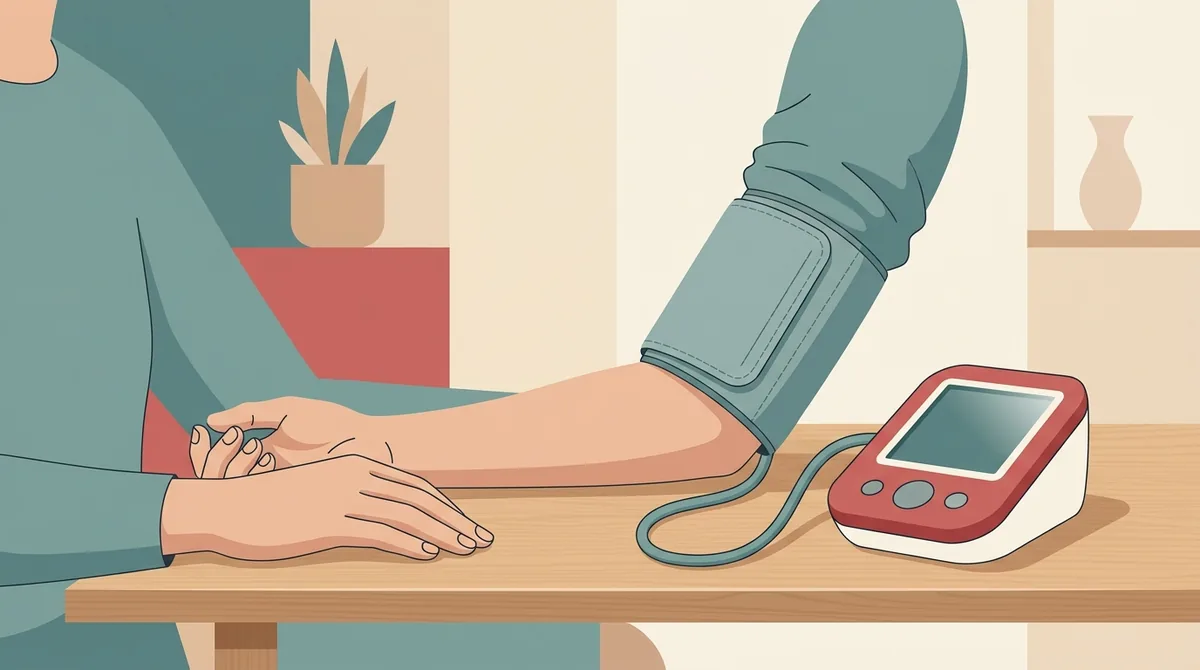
Sit still for five minutes first. Feet flat, back supported, arm resting on a table at heart height.
No coffee, no cigarette and no exercise in the thirty minutes before.
Take two readings a minute apart and use the second one. The first is nearly always higher.
A machine used badly gives worse information than no machine, and most of the surprising home readings people worry about come from skipping these steps.
Feet flat on the floor. Back against the chair. Arm resting on a table at heart height.
Sit still for five minutes first. Do not talk while it inflates.
The same time every day
Blood pressure moves through the day by a large margin, so a single reading tells you almost nothing.
What matters is the same two times each day, usually morning before medication and evening before dinner.
A week of that is a real picture. Three readings scattered across a month are not.
Write them down, or use a unit with an app. Which one doesn't matter as long as one of them happens.
Morning readings run higher for most people, and that's normal. What matters is comparing morning against morning.
Why your home reading differs from the clinic
Two effects, and they pull in opposite directions.
A lot of people read higher at a clinic simply because they're at a clinic. That's well documented and it has a name.
A smaller group reads normal at the clinic and high at home, which is the more concerning of the two.
So home readings aren't a second opinion to argue with. They're extra information your doctor actually wants.
What the numbers mean, briefly
The top number is the pressure while the heart beats. The bottom one is the pressure between beats.
Both matter, and the bottom one is often ignored even though it shouldn't be.
What counts as high depends on your age and your other conditions, which is why this page isn't going to give you a threshold.
Background on hypertension is worth reading, and your doctor's number for you is the one to act on.
Calibration and how long these last
Digital monitors drift over time, and most manufacturers suggest a check every two years.
In practice almost nobody does it. The simple version is to take your monitor to your next appointment and compare one reading against the clinic's.
If they're close, yours is fine. If they're far apart, replace it.
Cuffs also perish. A cuff that won't hold pressure is the usual reason an old monitor starts reading oddly.
Batteries or mains
Most of these run on four AA batteries and take an optional mains adapter that isn't in the box.
Batteries last several months of daily use, which is fine.
What isn't fine is weak batteries, because a monitor short of power can inflate slowly and read inconsistently before it warns you.
So replace them at the first low symbol rather than waiting for it to stop.
Four AA cells last several months of daily use. A mains adapter removes the worry and costs a few hundred rupees more.
The small sample problem
Two units on this page have very different ratings counts, and that's worth naming.
The HEM 7124 has more than seventeen thousand ratings. The Bluetooth HEM 7183T1 has 49.
I counted both from the listings on the day. A low count doesn't mean a bad product, it means there's very little evidence either way.
For a health device that's a fair reason to prefer the well reviewed option unless you specifically want the tubeless design.
Who should buy the expensive one
Somebody who travels a lot, because a tubeless unit packs smaller and has nothing to kink.
Somebody taking readings alone with limited hand strength, because the wrap cuff is easier to fit one handed.
Everybody else is paying nearly five times as much for the same measurement.
That's not a criticism of the product. It's a description of what the extra money buys.
Anybody whose doctor asked for a written log. The app writes it for you, and a phone screen at the appointment beats a notebook nobody can read.
What to buy alongside it
A notebook, if you aren't using an app. Readings with no dates are almost useless to a doctor.
A large cuff if your upper arm measures over 32 centimetres, because the standard one will read high.
And a mains adapter if an older relative will be using it, since changing batteries is one more thing to forget.
A weighing scale beside it covers the other number most doctors ask for.
What to buy in one line
Tight budget, arm cuff, no app: the Dr. Morepen BP 14 at ₹845.
Most households: the Omron HEM 7124 at ₹1,640, and it's the one I'd pick.
Doctor wants a two week log, or an older relative takes their own readings: the HEM 7183T1 at ₹2,385, and accept a ratings sample of under fifty.
Travel a lot: the tubeless HEM 7600T at ₹7,788.
All four are on our health shelf and prices move weekly.
Frequently Asked Questions
Is a wrist BP monitor as accurate as an arm one?
In practice no, because a wrist monitor has to be held at exactly heart height and almost nobody manages that consistently. Hold your wrist low and the reading climbs. An upper arm cuff sits at heart height by default, which is why every unit on this page uses one.
How do I know if the cuff is the right size?
Measure around the middle of your upper arm with a tape, then check the cuff range on the listing covers it. Standard cuffs usually run from about 22 to 32 centimetres. A cuff that's too small reads high and one that's too big reads low, by a meaningful amount.
Why is my reading different every time?
Blood pressure moves through the day, so that's normal. Sit still for five minutes first, keep your arm at heart height, and take two readings a minute apart using the second one. Then compare the same two times each day rather than comparing single readings.
Do I need Bluetooth on a BP monitor?
Only if somebody will actually look at the log. If your doctor asked for two weeks of morning and evening readings, an app saves a notebook and plots the trend they want to see. For a monthly check out of curiosity it's an extra thing to keep working.
How often should a home BP monitor be checked?
Manufacturers generally suggest every two years. The practical version is to take yours to your next appointment and compare one reading with the clinic's. If they're close it's fine. Cuffs also perish, and a cuff that won't hold pressure is the usual cause of odd readings from an old machine. If your doctor has also asked you to move more, our exercise cycle roundup covers the home options.